

Most machine tending Automation is bought for one of two reasons: the shop cannot find operators, or the shop cannot keep its spindles turning. Cobots address both — but only in the right production environment. Buy a collaborative robot for a job that runs 200,000 identical parts a year and you will regret the speed. Buy an industrial robot for a shop that changes jobs twice a day and you will regret the changeover.
This guide explains where cobot machine tending genuinely pays off, how a collaborative robot compares with an industrial robot on the same job, what safety still requires, and what a realistic budget looks like. It is written for shops that are weighing collaborative robot machine tending against a conventional robot cell — and want to get the decision right the first time.
What Cobot Machine Tending Changes in a CNC Shop
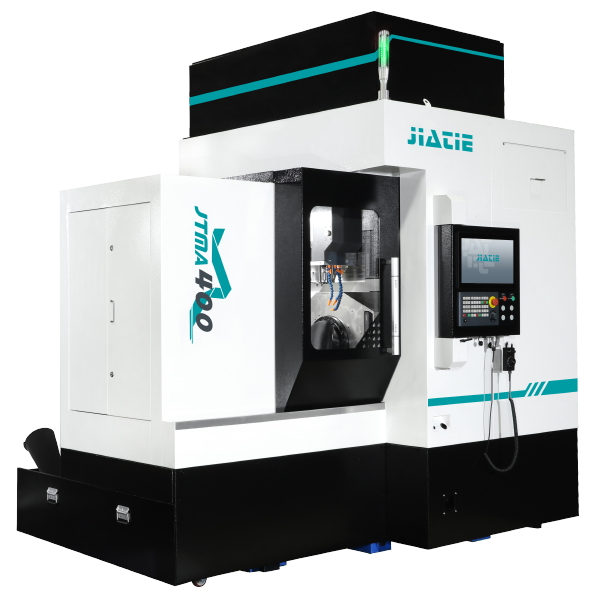
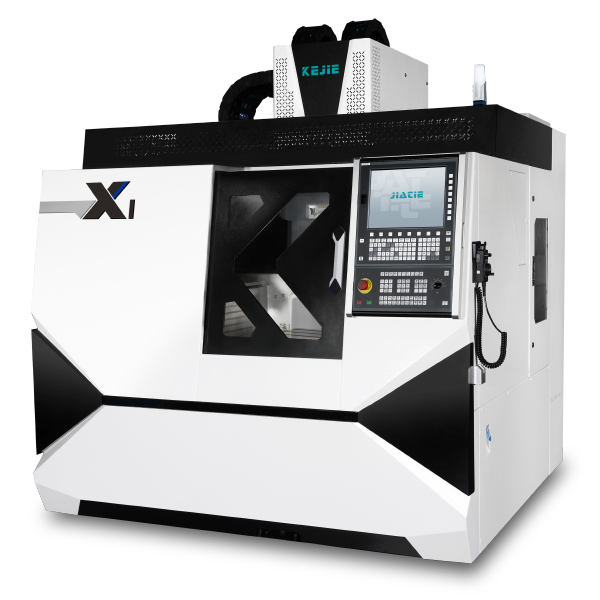
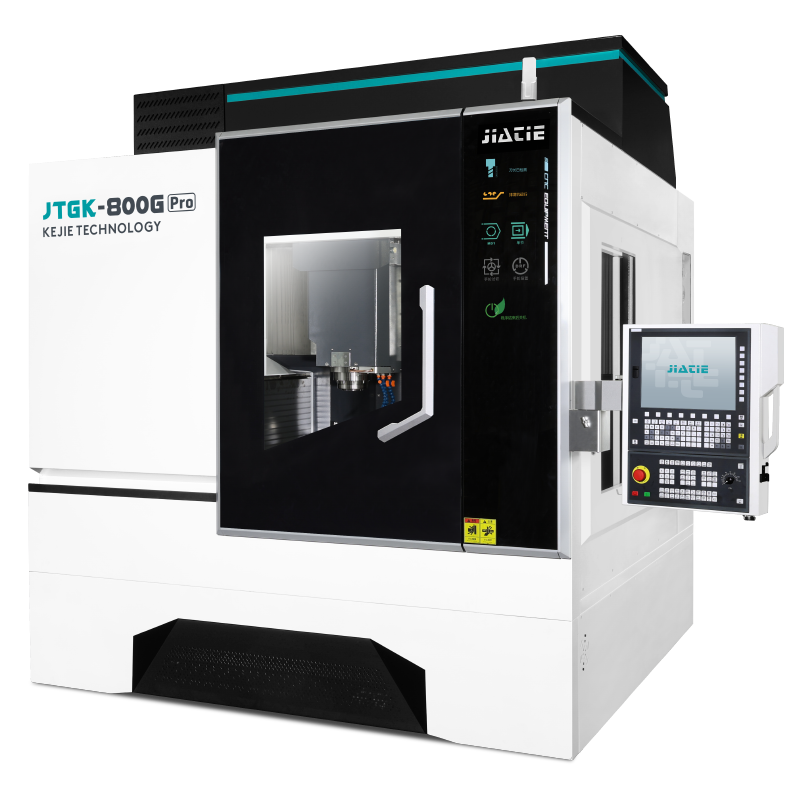
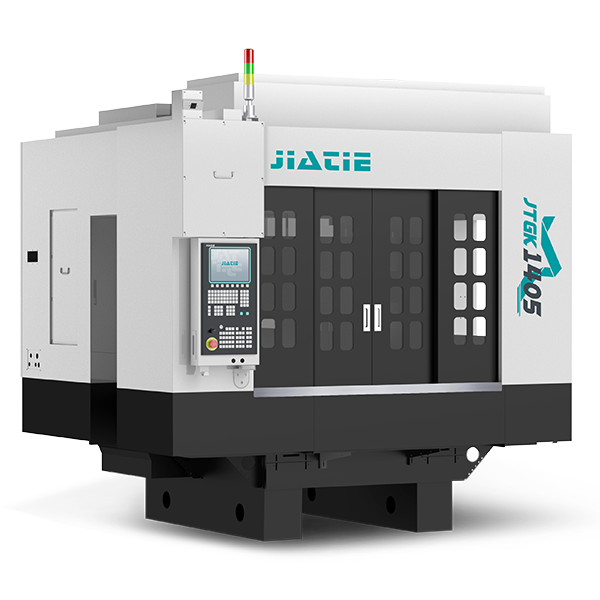
JTMA-400 5-Axis High Speed Machine used in a cobot machine tending cell
A collaborative robot is defined by its ability to work alongside people rather than by its shape. In practice, three differences matter on a CNC shop floor:
- Deployment speed. A cobot cell can often be installed and running in days rather than weeks, because the robot is light enough to mount on a bench, a base plate or a mobile stand without a foundation.
- Reprogramming by the shop. Parts are taught by hand-guiding the arm, so a new job can be set up by the machine operator instead of by an integrator on a service call.
- Layout freedom. A cobot can often be placed beside an existing machine without rebuilding the cell around it — valuable in shops where floor space is already tight.
None of these advantages are about speed. They are about how quickly the cell can be re-pointed at the next job, which is exactly what a high-mix shop needs. Machine tending cobots are therefore best understood as a changeover tool as much as a labour tool.
It is worth being precise about the comparison, because the terms are often used loosely. Robotic machine tending covers any robot that loads and unloads a machine tool. Cobot machine tending is the subset where the robot is designed to work safely alongside an operator. Both are forms of machine tending automation; they differ in how the cell is deployed and guarded, not in what the cell is for. If you are new to the subject, our earlier article on what CNC machine tending automation is and how it works is a useful starting point.
Cobot vs Industrial Robot: Which Machine Tending Robot Fits Your Production
| Factor | Cobot machine tending | Industrial robot machine tending |
|---|---|---|
| Best production profile | High mix, low to medium volume, frequent changeover | Low mix, high volume, long runs |
| Typical payload | 5–18 kg | 10–50 kg and above |
| Cycle speed | Slower, but usually still inside the machining cycle | Fastest; can serve several machines |
| Setup for a new part | Hours, often by your own operator | Days, usually with integration support |
| Safety approach | Risk assessment with speed and force limits | Risk assessment plus physical guarding |
| Footprint | Small; can be mobile | Larger; fixed installation |
| Typical installed cost | Lower entry point | Higher, but lower cost per part at volume |
A useful rule of thumb: if the same part runs for longer than a shift, look hard at an industrial robot or a gantry loader. If the machine is re-set several times a week, a cobot is normally the better machine tending solution.
Specifying the Arm: Payload, Reach and Speed
Three specifications decide whether a collaborative robot can do the job, and they interact:
- Payload. Take the weight of the part, add the weight of the gripper, and then add a margin — typically 20–30% — for acceleration forces and for the moment created when the part is held away from the wrist. A 6 kg part with a 4 kg gripper is not a 10 kg application.
- Reach. Measure from the robot base to the furthest point of the machine table and to the furthest point of the feed station. If either is out of reach, the whole cell layout has to change.
- Speed. Cobots are slower than industrial robots by design, because speed and force are limited for collaborative operation. The test is not whether the robot is fast in isolation, but whether its load and unload time fits inside the machining cycle with margin for a retry.
A fourth factor — repeatability — is rarely the limiting one for machine tending, since cobots typically hold ±0.05 mm, well inside what a located fixture needs. Where cobots do fall short is on heavy, high-force tasks, which is why deburring and heavy press loading usually stay with industrial robots.
Where a Machine Tending Cobot Wins
- Job shops and toolrooms. Small batches of many different parts are the natural home of collaborative automation, because the cell never has to be efficient at one part — only quick to change.
- Second-shift and lights-out running. Machine tending with robots lets a Machining Center or grinding machine keep cutting after the operator leaves, as long as parts can be presented and the process can run unattended.
- Shops without space for fencing. Removing the need for a full safety cage often decides the project, particularly in existing buildings.
- First automation project. A single robot tending cell is a lower-risk way to learn how automation behaves in your process before committing a full production line.
- Rapid redeployment. A cobot on a mobile base can be moved to whichever machine is the current bottleneck — a flexibility no fixed cell can match.
In all of these cases the goal is the same: machine tending solutions that are good enough at any single job, and fast to move on to the next one.
Where an Industrial Robot Still Wins
Collaborative robots are not a universal answer. Choose an articulated robot or a gantry loader when:
- Parts weigh more than roughly 15–18 kg, or are large and awkward to grip.
- The part must be moved at a speed a cobot cannot safely achieve.
- One robot will tend two or three machines, where reach and speed dominate.
- The cell runs the same family of parts for months, so changeover speed is irrelevant.
- The process involves high forces — heavy clamping, deburring, or press loading.
Safety With a Collaborative Robot: What the Risk Assessment Still Requires
"Collaborative" describes a capability, not a guarantee. Before a cobot machine tending cell runs, the following still have to be documented:
- A risk assessment covering the robot, the gripper, the part, the machine tool and the operator's tasks.
- Verified speed and force limits for any contact that can occur during normal operation.
- A safe state for the machine tool — door interlock, spindle stop, and a defined signal exchange with the robot controller.
- Protection against the specific hazards of your process, such as swarf, coolant mist, hot parts and sharp edges.
In practice the risk assessment is where a machine tending project is won or lost. A supplier who treats it as paperwork will leave you with a cell that cannot be signed off.
What a Cobot Machine Tending Cell Costs and How Fast It Pays Back
A single-machine cobot cell typically lands in the range of USD 40,000–70,000 installed, covering the arm, a gripper, a part presentation station, a controller interface to the machine, and commissioning. The variables that move the number most are the gripper design and how the parts are presented. Suppliers who build custom robotic cells for machine tending will usually quote the cell as a whole; be cautious of a quotation that prices only the robot.
It also helps to compare against the alternative honestly. A fully automated machine tending line with automatic feeding and pallet handling may cost two or three times as much, but it will run parts at a rate a cobot cannot match. The cobot wins when changeover matters more than throughput.
| Item | Typical share of cell cost | Note |
|---|---|---|
| Cobot arm and controller | 30–40% | Payload and reach drive the price |
| End-of-arm tooling | 10–20% | Dual grippers cost more but save cycle time |
| Part feeding / presentation | 10–25% | Random bin picking is the expensive option |
| Safety and guarding | 5–15% | Lower than an industrial cell, not zero |
| Integration and commissioning | 15–25% | Machine interface, programming, training |
Payback is driven by recovered spindle hours. If the cell lets a machine run through breaks and a second unattended shift, the recovered hours are usually enough to justify the investment within two to four years on a single machine — faster if the shop is currently turning work away.
Machine Tending Fixtures and Part Presentation for Cobots
Cobots are more sensitive to part presentation than industrial robots, because their reach and speed leave less margin for correction. Three practical points:
- Machine tending fixtures should locate, not just hold. A fixture that places the part in a repeatable position removes the need for vision and cuts cycle time.
- Design for the finished part as well as the raw part. The gripper must hold a burr-free finished surface without marking it, which often means two different gripping strategies in one tool.
- Keep the machine tending stations within easy reach. Fewer axes of movement means a shorter, more reliable cycle — and a cell that is easier to re-teach for the next job.
FAQ
Can a cobot load a CNC lathe as well as a machining center?
Yes. Cobots are commonly used for lathe tending and for loading vertical and Horizontal Machining Centers. The constraint is access to the work area and whether the door can be opened automatically and safely by the cell.
How long does it take to change over a cobot cell to a new part?
With a well-designed gripper and a located fixture, a new part is usually a matter of hours — a new gripper jaw set, a re-taught path and a short trial run. That is the core advantage of cobot machine tending.
Do I still need a fence around a collaborative robot?
Not always, but often. The risk assessment determines it. Where the cobot moves a heavy or sharp part, or reaches into a machine tool, additional guarding or light curtains are frequently required.
Is a cobot fast enough to keep up with my machine?
In most cases yes, because the robot only needs to load and unload inside the machining cycle. If the machining cycle is shorter than roughly 60–90 seconds, an industrial robot or gantry loader is usually the better choice.
Building a Cobot Machine Tending Cell With Kejie
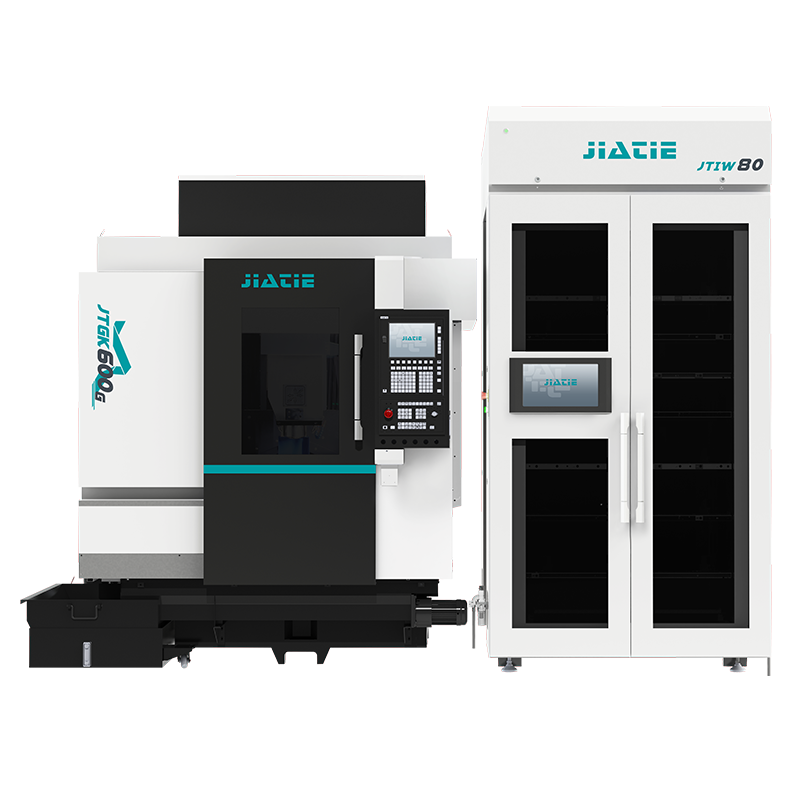
Kejie designs and builds the machine tool and the automation that loads it. Our automation range — including the JTGS-600Au and JTHS-600Au units and the JTIW-80 flexible automation unit — is engineered against our own machining centers, grinding machines and 5-axis machines, so the interface between robot and machine is defined from the start. More detail is on our automated processing solutions page.
Send us your part, your batch size and your machine model, and we will tell you whether a collaborative cell is the right answer — or whether an industrial robot or gantry loader will serve you better.